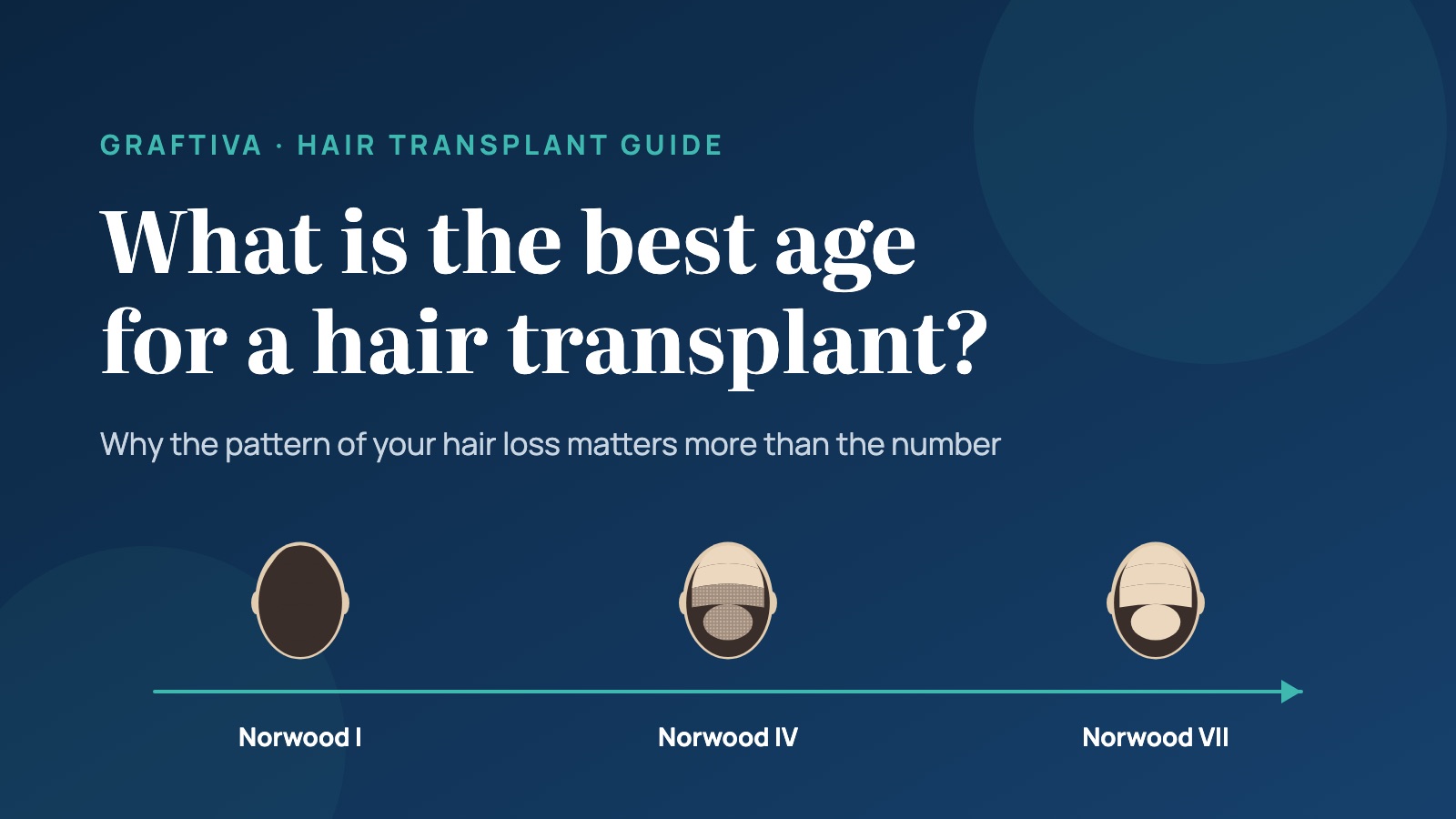
Is there a best age for a hair transplant? Age matters less than how predictable your hair loss is: in a study of 5,372 Japanese men, moving from one Norwood stage to the next took about 4.5 years on average.[1] This guide shows how hair loss changes by decade, why doctors are careful under 25, and what our doctors in Istanbul check before saying yes.
In short
A transplant works best once the pattern of hair loss is clear, which for many men is from the late twenties onwards. Under 25 it is possible in selected cases, but the plan has to be cautious, because the loss often keeps moving. There is no upper age limit for a healthy person with a good donor area.
At a glance
- Best time
- When the pattern is clear and stable
- Under 25
- Possible, with a cautious, long-term plan
- Upper age
- No fixed limit; health and donor decide
- Progression
- About 4.5 years per Norwood stage in one large study
- Often first
- Medication to protect the hair you have
Why “how old am I?” is the wrong first question
Age matters, but only because it tells the doctor something about the future of your hair.
A hair transplant moves hair; it does not create new hair. Grafts are taken from the back and sides of the head, where follicles resist pattern hair loss, and placed where hair has thinned.[6] The number of grafts you can ever move is limited, so every plan is really a decision about where to spend a fixed budget.
That is why age comes up in every consultation. At 22, the doctor is planning around hair loss that has only just started and may have a long way to go. At 45, most of the pattern is visible and far easier to plan for. The same hairline can be a good decision in one of those patients and a poor one in the other.
So the useful question is not “am I old enough?” but “can my doctor see where my hair loss is heading, and is there enough donor hair to follow it?” The rest of this article explains how those two things change with age.
How hair loss changes with age
Pattern hair loss usually starts gradually and moves through recognisable stages. Two studies give a sense of the pace.
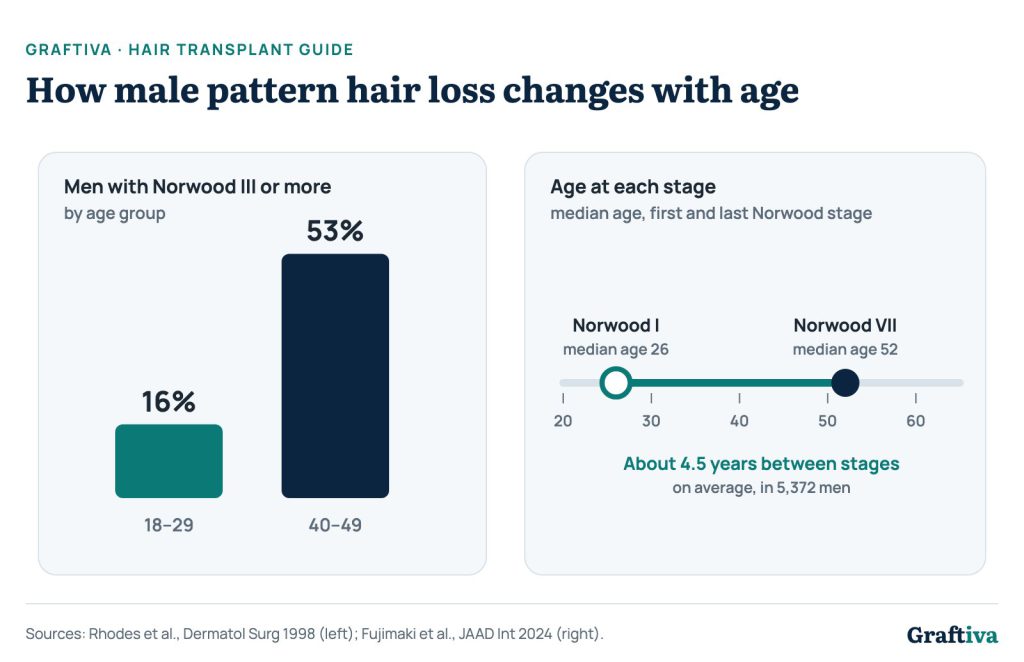
In a community study of healthy men, 16% of those aged 18 to 29 already had at least moderate hair loss (Norwood III or more). Among men aged 40 to 49 it was 53%.[2] In Turkey, a community study of adults aged 20 and over found pattern hair loss in about 48% of men and 19% of women.[4]
The Norwood scale describes these stages for men, from a slight recession at the temples to hair remaining only at the back and sides.[3] It is the same scale used on our before and after cards and in the graft calculator.
A large Japanese study of 5,372 men gives a sense of timing. The median age was 26 at the first Norwood stage and 52 at the last, and men took on average about 4.5 years to move from one stage to the next.[1]
Those are averages from one population, and your own pace can be faster or slower. But they explain why doctors are careful with young patients: someone at Norwood II in their early twenties may still have several stages ahead.
Your donor area is a lifetime budget
The grafts you use now are grafts you cannot use later. Planning for age is mostly planning for that.
The back and sides of the scalp hold a limited number of follicles that can be moved safely. Remove too many and the donor area itself starts to look thin. Researchers now describe the “safe” donor zone as something to define for each patient rather than a fixed band, partly because it can shrink if hair loss progresses.[9,10]
This is where age matters most. A young patient may need grafts for hair they will lose in ten or twenty years. If a large part of the donor budget goes on a low, dense hairline at 23, there may not be enough left to cover the crown at 40, and the result can look odd: a full front with thinning behind it.[6,7]
How our graft calculator allows for age
Our graft calculator estimates how many grafts your donor area could supply in total, then holds part of that back as a reserve for future hair loss. The younger you are, the larger the reserve:
| Age | Held back for later | Available now |
|---|---|---|
| Under 25 | 40% | 60% |
| 25 to 34 | 30% | 70% |
| 35 to 49 | 20% | 80% |
| 50 and over | 10% | 90% |
These are planning assumptions, not medical rules. They mirror the way doctors think about the donor area: the earlier you start, the more you keep in reserve. In consultation the doctor replaces them with what they see in your scalp.
What changes in each decade
A general guide. Your own pattern, family history and donor area matter more than the band you fall in.
| Age | What is usually going on | What the doctor weighs | Common approach |
|---|---|---|---|
| 18 to 24 | Hair loss is often recent and may be moving quickly. The final pattern is hard to predict. | Speed of change, family history, donor density, expectations. | Medication first; if surgery, a conservative hairline and fewer grafts, with donor kept in reserve.[7,8] |
| 25 to 34 | The pattern is becoming clearer, but many men are still changing. | Whether the loss has been stable for a year or two; how far it may go. | Transplant for the front with a mature hairline; medication to protect the rest. |
| 35 to 49 | For many men the pattern is largely visible. | Total area to cover against donor supply; crown versus front. | Often the most predictable time to plan; larger sessions where the donor allows.[1] |
| 50 to 64 | The pattern is usually settled. Grey hair and lighter contrast can make coverage look fuller. | General health, medicines, donor quality, realistic density. | Transplant to frame the face and cover key areas; health checks before surgery. |
| 65 and over | Hair loss is rarely the only consideration. | Fitness for a long procedure under local anaesthesia, blood thinners, healing. | Possible for healthy patients after medical review; smaller, well-targeted sessions.[11] |
Young patients
Under 25: when waiting is the better choice
Hair loss in the late teens and twenties can be hard to live with, and it is reasonable to want to act.[7] Most guidance does not say “never” to young patients; it says “not yet, or not like that”. The risk is not the operation itself. It is spending donor hair on a pattern that is still changing.
Medical treatment is the usual first step. Finasteride or minoxidil can slow or partly reverse thinning, and their effect is easier to judge before any surgery.[8] Some changes in young people are not pattern hair loss at all, such as alopecia areata or shedding after illness, and they need a diagnosis rather than grafts.[6]
Reasons a doctor may suggest waiting
- Your hair has thinned noticeably in the last year.
- Close relatives lost most of their hair, especially early.
- Thinning is spread across the top rather than at the temples or crown.
- You want a low, straight, teenage hairline.
- You have not tried, or cannot use, medical treatment.
When a young patient can be a reasonable candidate
- The loss has been stable for a year or two.
- The area is limited, for example the temples.
- The donor area is dense and healthy.
- You accept a mature hairline and a long-term plan.
- The cause is a scar, an injury or traction rather than pattern loss.
In your 40s, 50s and beyond
Older patients are often easier to plan for. The questions shift from “where is this going?” to “what can my donor and my health support?”
Predictable
The pattern is clearer
By middle age most men can see the shape of their hair loss, which makes the plan more reliable.[1] The doctor can decide early whether to cover the whole top or focus on the front.
An advantage
Grey hair can help
Lighter hair on light skin hides scalp better than dark hair, so the same number of grafts can look fuller. The hairline is also designed to suit your age, not a younger face.
Checked first
Health comes first
Blood pressure, diabetes and blood thinners are reviewed before surgery, and the session may be shorter. Complications after transplants are uncommon, but they are taken seriously at any age.[11] See how to prepare.
Women
For women, age is a weaker guide
Female pattern hair loss becomes more common with age: in one Australian community study, more than half of women aged 80 and over had thinning at the front and top.[5] In the Turkish community study, about one in five adult women had pattern hair loss.[4]
But for women the deciding factor is usually the type of hair loss, not the birthday. Diffuse thinning across the whole scalp, including the donor area, is a poor fit for a transplant at any age. A stable, well-defined area or a high hairline can be a good one.[6,8]
That is why women are usually assessed for the cause of thinning first, and many start with medical treatment.[8] Read more in our guide to female hair transplants.
Afro-textured hair adds another consideration at any age: traction from tight styles can cause hair loss at the edges that looks like pattern loss. That needs to be identified first; see Afro hair transplants.
What the doctor checks before saying yes
Age is one line on this list. These are the questions that actually decide the plan.
- The pattern and its speed. Which Norwood or Ludwig stage you are at now, and how much it has changed in the last one to two years. Old photos help.
- Family history. How far, and how early, hair loss went in parents, grandparents and brothers.
- The donor area. How dense it is, how large the safe zone looks, and whether it shows any thinning itself.[9]
- The cause. Whether this is pattern hair loss at all, or something that needs a different treatment.[6]
- Medication. Whether you use, or could use, treatment to protect the hair you have.[8]
- The long-term plan. Where future grafts would go if your hair keeps thinning, and whether a second session may be needed.
- Your health and expectations. Medical history and medicines, and whether the result you want is realistic for your hair.
Age and hair transplants: frequently asked questions
Is 18 too young for a hair transplant?
For pattern hair loss, usually yes. At 18 the final pattern is very hard to predict, and medical treatment is the normal first step. The exceptions are things like scars or injuries, where the area will not change.
Can I have a hair transplant at 21 or 22?
Sometimes, if the loss is limited and has been stable, the donor area is strong and you accept a conservative, mature hairline. Many doctors will want you on medical treatment first and will keep a large part of the donor area in reserve.
What is the oldest age for a hair transplant?
There is no fixed upper limit. What matters is your general health, your medicines and the quality of your donor area. Healthy patients in their 60s and 70s can be treated after a medical review.
Is it better to wait until I am completely bald?
No. Waiting until you are very bald usually means covering a larger area with the same donor supply. The aim is to plan once the pattern is clear enough to predict, not to wait for it to finish.
Will I need another transplant when I am older?
Possibly. The transplanted hair usually keeps growing, but hair that was not transplanted can continue to thin. That is why the plan keeps donor hair in reserve and why medication is often recommended.
Does age affect how well the grafts grow?
Graft growth depends more on handling, technique and your scalp and general health than on age itself. The doctor checks the factors that matter for you, such as smoking, blood thinners and healing.
What age is best for women?
There is no best age. Women are usually assessed for the cause of their thinning first, and a transplant is considered when the area is stable and well defined and the donor area is strong.
Sources
Research behind this article
Medical statements in this article are based on the peer-reviewed sources below, chosen under our editorial policy. The calculator reserve figures are Graftiva planning assumptions.
- Fujimaki H, Yanagisawa M, Yoshitake T, Sato A. Age-related progression of androgenetic alopecia: statistical analysis of 5372 Japanese men. JAAD Int. 2024;17:84-85. PubMed
- Rhodes T, Girman CJ, Savin RC, et al. Prevalence of male pattern hair loss in 18-49 year old men. Dermatol Surg. 1998;24(12):1330-1332. PubMed
- Norwood OT. Male pattern baldness: classification and incidence. South Med J. 1975;68(11):1359-1365. PubMed
- Bas Y, Seckin HY, Kalkan G, et al. Prevalence and types of androgenetic alopecia in north Anatolian population: a community-based study. J Pak Med Assoc. 2015;65(8):806-809. PubMed
- Gan DC, Sinclair RD. Prevalence of male and female pattern hair loss in Maryborough. J Investig Dermatol Symp Proc. 2005;10(3):184-189. PubMed
- Jimenez F, Alam M, Vogel JE, Avram M. Hair transplantation: basic overview. J Am Acad Dermatol. 2021;85(4):803-814. PubMed
- Bhatti HA, Basra MK, Patel GK. Hair restoration approaches for early onset male androgenetic alopecia. J Cosmet Dermatol. 2013;12(3):223-231. PubMed
- Kanti V, Messenger A, Dobos G, et al. Evidence-based (S3) guideline for the treatment of androgenetic alopecia in women and in men – short version. J Eur Acad Dermatol Venereol. 2018;32(1):11-22. PubMed
- Umar S, Gupta AK, Economopoulos V, Talukder M. Redefining the safe donor area in follicular unit excision: toward dynamic, patient-specific zones. J Cosmet Dermatol. 2026;25(10):e71250. PubMed
- Zontos G, Gupta AK, Economopoulos V, et al. A geometric framework for predicting donor area thinning after follicular unit excision. J Cosmet Dermatol. 2026;25(9):e71156. PubMed
- Khatib M, Skorochod R, Wolf Y. Complications following hair transplantation: a systematic literature review and meta-analysis. Aesthetic Plast Surg. 2025;49(23):6393-6405. PubMed
About the authors