For women · Istanbul
Female Hair Transplant in Turkey
A hair transplant can restore a widening parting, thinning on top, a high hairline or edges lost to tight styles, but only when the cause of the hair loss is known and the back of the scalp is strong enough to give. At Graftiva, a doctor-led hair transplant clinic in Turkey, we check both before we plan anything, and most women keep their hair long throughout.

Clinically reviewed by Dr. Harun Eymen Alakaya, MD, hair restoration physician
Key facts
- Best suited to
- Stable pattern thinning with a strong donor area
- Usual method
- Unshaven (long hair) FUE; DHI for small areas
- Shaving
- A narrow band at the back, hidden under your hair
- Before surgery
- The cause of your hair loss is checked first
- Anaesthesia
- Needle-free numbing, then local
- Back to desk work
- After 2 to 3 days
- Final result
- 12 to 18 months
- Price
- $4,545 / €4,000, fixed
Quick answers
Hair transplant for women: the short version
Can women have a hair transplant?
Yes, when the hair loss has a pattern, is stable, and the back and sides of the scalp are still dense. Thinning that covers the whole scalp is not suitable.
Do I have to shave my head?
Usually not. Most women have an unshaven procedure: only a narrow band at the back is trimmed, and the hair above it covers it.
Will it stop my hair loss?
No. A transplant moves hair to thin areas, but female pattern hair loss can continue around it. Most women also need medical treatment.
What do you check first?
Your history, a magnified look at your scalp and, depending on what we find, blood tests such as iron and thyroid.
How much does it cost?
An unshaven female hair transplant at Graftiva has a fixed price of $4,545 / €4,000. It does not change with the number of grafts.
When will I see results?
New hair usually appears from month 3, the most visible change comes at months 6 to 9, and the final result is judged at 12 to 18 months.
Video summary
Female hair transplant in 60 seconds
Why the cause of your thinning decides whether a transplant makes sense, how the doctor checks the back of your scalp, how most women keep their length, and what the year after surgery looks like. Watch it first, then read the detail below.
In this video
Read the transcript
A hair transplant can help women too, but the plan starts with the cause, not the grafts. A widening parting often means female pattern hair loss. Thinning all over the scalp, or shedding that is still active, needs a different answer. Every graft comes from the back of the scalp. In women it can thin too, so the doctor checks it under magnification first. Most women keep their length. Only a narrow band at the back is trimmed, and grafts go between the hairs you already have. A transplant does not stop pattern hair loss, so most women also continue medical treatment. Desk work is usually possible after 2 to 3 days. New hair appears from month 3, and the final result comes at 12 to 18 months. An unshaven female transplant has one fixed price: $4,545 / €4,000. Start with a free hair analysis at Graftiva.
Diagnosis first
Why the cause of your hair loss comes first
Female pattern hair loss is the most common reason women lose hair, and it becomes more common with age.[1,2] But several other conditions look similar from the mirror, and some of them make a transplant pointless or harmful.[6]
Pattern hair loss is common: the European S3 guideline reports that it affects up to 42% of women.[2] It is also more than cosmetic. In a 2024 study of 202 women with female pattern hair loss, quality of life, depression and anxiety scores all worsened as the hair loss became more severe.[3]
| Cause | What it usually looks like | Transplant? | What happens first |
|---|---|---|---|
| Female pattern hair loss | A widening parting and thinning on top; the front hairline usually stays | Often yes, when stable and the donor area is strong | Medical treatment usually continues before and after surgery[1,7] |
| Diffuse unpatterned thinning (DUPA) | Thin all over, including the back and sides | No | Medical treatment; taking grafts would thin the donor area further[6] |
| Telogen effluvium (shedding) | Sudden heavy shedding a few months after illness, childbirth, stress, dieting or a new medicine | No, it often settles | Find the trigger; reassess once shedding has stopped. Long-lasting shedding is sometimes early pattern hair loss[5] |
| Hormonal causes (PCOS, thyroid) | Thinning with irregular periods, acne or extra body hair, or with thyroid symptoms | Possibly, once treated | Hormone and thyroid tests and treatment by your doctor[4] |
| Traction alopecia | Thinning at the edges and temples from tight ponytails, buns, braids or extensions | Yes, if long-standing and the pulling has stopped | Stop the tension; early cases can regrow[9] |
| Scarring hair loss (e.g. FFA, LPP, CCCA) | Shiny skin, redness, itching or a receding band at the front | Only after a long quiet period, with a test first | Specialist treatment; grafts can survive less well over the years[8] |
| Alopecia areata | Round, smooth patches that can come and go | No | Medical treatment by a dermatologist |
| Scars after a facelift, brow lift or injury | A hairless line or patch near the hairline or ears | Often yes | The scar is examined; grafts are placed into it[10] |
Not sure which row is yours? That is normal. Send us photos of your parting, hairline and the back of your head, and the doctor will tell you what he sees before you plan any travel.
With women I never start with grafts. I start with the cause, because a transplant cannot fix thinning that is still being driven by hormones, shedding or tight styling, and it may take donor hair you will need later.
Dr. Harun Eymen Alakaya, MDHair Restoration Physician, Graftiva ClinicThe donor area
Is the back of your scalp strong enough?
Every graft comes from the back and sides of the scalp. In men this area is usually spared by pattern hair loss. In women it is often affected too, more quietly, and it is the most common reason we advise against surgery.[1,6]
Under magnification, a strong donor area has follicular units with two or three thick hairs. A weakened one has more single hairs, and hairs of very different thickness side by side. Grafts taken from such an area can keep thinning after they are moved, and taking them thins the back as well.
This is also why the number of grafts a woman can safely give is usually lower than a man’s, and why we plan conservatively.
Before we plan
What we check before surgery
Women often tell us no one ever explained why a test was needed. Here is what we look at, and why.
01
Your history
When the thinning started, how fast it changed, recent illness, childbirth, dieting or stress, your medicines, contraception, menstrual cycle, the styles you wear and family history. Most diagnoses start here.
02
A magnified scalp examination
The doctor looks at the top and the donor area under magnification, comparing hair thickness and how many hairs grow together. This shows miniaturisation and signs of scarring that are invisible to the eye.
03
Blood tests where they help
An EKG and blood tests are part of every surgery day. If your history points to it, the doctor may also ask for iron stores (ferritin) and thyroid function, and hormone tests when there are signs of androgen excess such as irregular periods, acne or extra body hair.[1,4]
04
Your own doctor’s notes
If you have seen a dermatologist or gynaecologist, or had a scalp biopsy, please send the reports with your photos. They often save time and change the plan.
Keeping your length
Can you keep your hair long?
In most cases, yes. Women at Graftiva usually have an unshaven (long hair) FUE: nothing on top is shaved, and only a narrow band at the back is trimmed.
At the back
Grafts are taken from a trimmed band low on the back of the scalp. The hair above it falls over the band, so it is hidden as soon as you let your hair down. How wide the band is depends on how many grafts you need.
On top
Grafts are placed between your existing hairs, which stay uncut. For small, concentrated areas such as the front edge, a DHI pen can place grafts without opening channels first.
Larger sessions
If you need a large number of grafts, a wider band or a short cut at the back may be needed. The doctor tells you before you travel, not on the day.
Most women I treat want to walk out of the clinic looking like themselves. Placing grafts between the hair you already have takes longer, but it means nothing on top has to be cut.
Dr. Harun Eymen Alakaya, MDHair Restoration Physician, Graftiva ClinicWhat it can treat
What a hair transplant can do for women
Parting and top
A widening parting
The most common request. Grafts are placed along and around the parting, between existing hair.
- Best when the loss is stable and medically treated
- Adds coverage; it does not create a full-density scalp
- Planned with the parting you actually wear
Edges and temples
Hair lost to tight styles
Long-standing traction loss at the edges can be restored once the pulling has stopped.[9]
- Smooth edges with no regrowth for a long time
- Tight styles must not return on the new hair
- Afro-textured hair: our separate guide
Scars
After a facelift, brow lift or injury
Hair loss along a facelift scar near the temple or ear is a well-described use of hair transplantation.[10]
- Scar must be fully healed
- Grafts are placed into the scar at the angle of the hair around it
Scarring hair loss needs particular caution. In a 2025 systematic review of 8 studies and 123 patients treated for inactive scarring alopecia, the share of grafts still growing was 82.7% at 7 to 12 months but 39.6% at 49 to 72 months.[8] That is why we only consider it after a long quiet period, and often with a test session first.
High forehead
Lowering a high hairline
Some women have a naturally high forehead rather than hair loss. A transplant can bring the hairline lower and soften the temple corners.[12]
In a 2019 study of 89 women who had their hairline lowered with grafts, no complications such as folliculitis, cysts or facial asymmetry were reported, and patients rated their satisfaction 4.2 out of 5.[12]
| Lowering with grafts (what we do) | Surgical hairline lowering | |
|---|---|---|
| How it works | Grafts are placed in front of the current hairline | A strip of forehead skin is removed and the scalp is moved forward[11] |
| Scar | Small dots at the back, hidden under your hair | A fine line along the new hairline |
| When you see it | Growth from month 3; final at 12 to 18 months | Immediately |
| Density | Depends on the donor area; a second session is sometimes planned | Full density at once |
| Who it suits | Women with a strong donor area, also when temples need rounding | Women with a stable hairline and a loose, mobile scalp[11] |
Surgical hairline lowering is a separate operation by a plastic or facial surgeon. If the doctor thinks it would suit you better, he will tell you.
Timing
Pregnancy, PCOS and menopause: when is the right time?
Pregnant or trying
Surgery waits
We do not plan a hair transplant during pregnancy. Several medicines used for female hair loss, such as oral minoxidil and spironolactone, are not used in pregnancy and need contraception advice, so tell us if you are planning a family.[14,15]
After childbirth
Let the shedding settle
Heavy shedding a few months after birth is common and usually recovers on its own. We assess you once the shedding has settled, and plan surgery after breastfeeding, when the hair you have left shows the real picture.[5]
PCOS
Treat the hormones too
Pattern hair loss is more common with PCOS, although hormone levels can be normal.[4] A transplant can help once the hormonal side is treated; without it, the hair around the grafts keeps thinning.
Existing hair
Will my existing hair fall out after surgery?
Some of it can. Because grafts are placed between the hair you already have, some of those hairs may shed in the weeks after surgery. In large reviews, temporary shedding was reported in up to about 6.5% of patients around the treated area, and it usually grows back within a few months.[13]
Women appear to be more prone to it. In a 2024 study of 621 patients, temporary shedding after FUE occurred in 14 of 67 women compared with 9 of 554 men.[17]
Women notice it more because they start with more hair on top. We tell you in advance, and it is one reason medical treatment before surgery helps: it strengthens the hairs that are already weak.
Medical treatment
A transplant does not stop female pattern hair loss
Transplanted hair comes from a resistant area and tends to stay. The hair around it does not change its nature, so most women need medical treatment as well.[1,7]
- Topical minoxidil is the only treatment approved for female pattern hair loss in the US.[14]
- Low-dose oral minoxidil is used off-label, following an international expert consensus.[15]
- Antiandrogens such as spironolactone help some women, depending on age, hormones and contraception.[14]
- PRP improved density and thickness in a 2024 meta-analysis of 21 studies with 628 participants, and is used alongside, not instead of, other treatment.[16]
The doctor explains which options suit you. Long-term treatment is usually continued with your own doctor at home.
Your visit
Your days in Istanbul
| When | What happens |
|---|---|
| Before you fly | The doctor reviews your photos and reports, explains whether a transplant is the right step, and sends a plan. |
| Surgery morning | A 40 to 60 minute consultation with the doctor, EKG and blood tests, and your hairline or parting plan drawn and agreed with you. |
| The procedure | Needle-free numbing, then local anaesthesia. Grafts are taken from the trimmed band and placed between your existing hair, with breaks for meals and rest. |
| Next day | Check-up and first wash at the clinic, with written aftercare instructions. |
| Going home | Most patients fly home after 2 to 3 nights, with 12 months of online follow-up. |

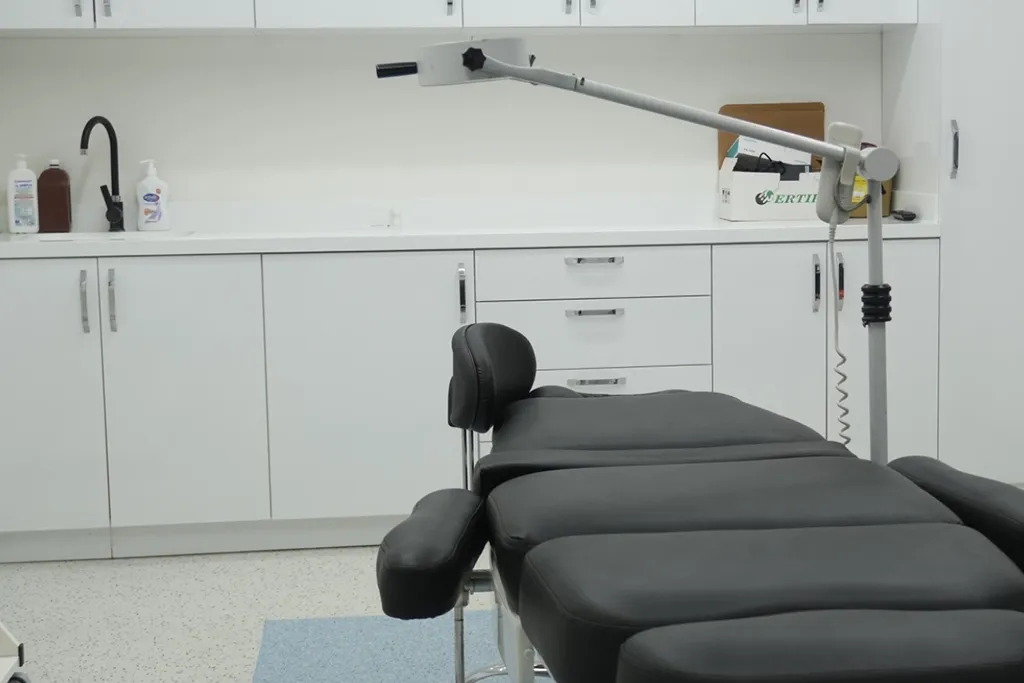
Each doctor treats at most two patients a day. See the clinic.
Recovery
Recovery for women: hair, work and styling
| Your question | What to expect |
|---|---|
| Washing | First wash at the clinic the day after surgery, then gently at home as shown. |
| Wearing your hair | Loose from the first days. Avoid ponytails, clips and buns that pull on the treated area until the doctor says the grafts are secure. |
| Going back to work | Desk work is usually possible after 2 to 3 days. With an unshaven procedure, most colleagues will not notice. |
| Headscarf or hijab | A loose, clean scarf that does not press on the grafts. Tell us if you wear one and we will show you how in the first days. |
| Hair colour and treatments | Not until your scalp has healed and the doctor clears it at your follow-up. |
| Extensions, toppers and wigs | Nothing glued, clipped or pulling on the treated area until the doctor clears it. A loose hat can be worn. |
| Exercise, sauna and sun | Light exercise from about day 10, full training from week 4; no sauna or pool for a month; keep the scalp out of direct sun. |
Your team
Who will treat you
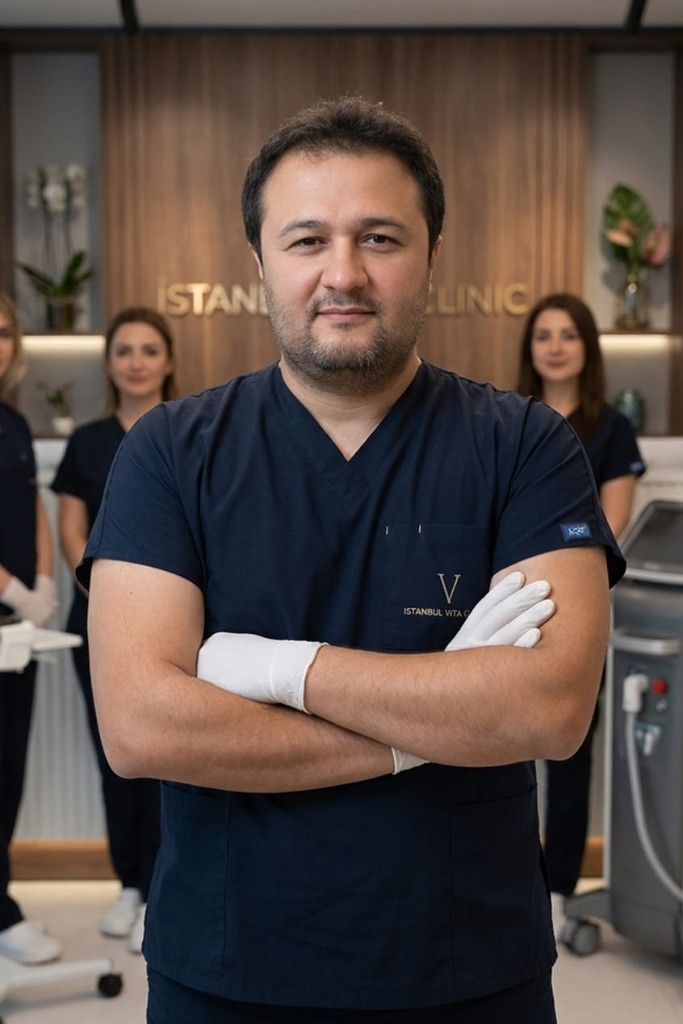
Lead doctor
Dr. Harun Eymen Alakaya, MD
Diagnoses the cause, decides whether surgery is right and opens every recipient channel himself.

Hairline design
Tuğçe Yılmaz Arslan
Draws your hairline or parting plan with you on the morning of surgery.

Donor assessment and planning
Mustafa Ayhan Balcı
Assesses donor density and plans how many grafts can safely be taken.
Cost
Female hair transplant cost in Turkey (2026)
An unshaven female hair transplant at Graftiva has a fixed price of $4,545 / €4,000. It does not change with the number of grafts or if the doctor adjusts the plan during your consultation.
If the doctor recommends a shaved procedure instead, you will know the price before you book.
Included
- Consultation with the doctor, EKG and blood tests
- Unshaven FUE, with DHI where planned
- PRP and mesotherapy, oxygen therapy
- Aftercare package and first wash at the clinic
- Graft Guarantee Certificate
- 12 months of online follow-up and 24/7 medical assistance
- In-clinic translator
Flights are not included. Your written quotation lists everything that is, including accommodation and transfers.
Honesty first
When we advise against surgery
- Thinning across the whole scalp, including the back and sides
- Shedding that is still active, or started only recently
- Scarring hair loss that is not quiet
- A hormonal cause that has not been treated
- Expectations a transplant cannot meet, such as the density you had at twenty
If any of these apply, we tell you before you travel and explain what could change the answer.
Results
How to judge women’s before and after photos
- The parting view, not only the front. Most female results show at the parting.
- Dry hair, same parting, same light. Wet or teased hair changes how density looks.
- The month. A photo at month 6 is not the final result.
- Shaved or unshaven, the graft count and the area treated.
Real results
Female hair transplant before and after
Results for women with stable thinning on top (Ludwig II), treated by our team. Each case shows the grafts and the month the after photo was taken, from month 9 to 12.
GFV-0001Women
2,500 Grafts Sapphire FUE
GFV-0004WomenAfro-textured
3,000 Grafts Sapphire FUE
GFV-0010Women
3,500 Grafts Sapphire FUE
GFV-0007WomenAfro-textured
3,500 Grafts Sapphire FUE
Individual results vary. Faces are blurred for privacy; the hair is not retouched.
FAQ
Female hair transplant: frequently asked questions
Is a hair transplant for women different from one for men?
Yes. Women usually lose hair at the parting and on top rather than at the hairline, the donor area is more often affected, and most women want to keep their length. That changes who is suitable, how many grafts can be taken and how the procedure is done.
How many grafts does a woman need?
It depends on the area, the density you start with and what your donor area can safely give. The doctor gives an estimate from your photos and confirms it after examining you. Our price for women is fixed and does not change with the number.
Will anyone see that I had a transplant?
With an unshaven procedure, the trimmed band at the back is covered by the hair above it, and the hair on top is not cut. Some redness and small crusts on top can be visible for about two weeks if you part your hair over them.
Is FUE or DHI better for women?
Both start with FUE extraction. DHI places grafts with a pen and suits small, concentrated areas such as the front edge; channels opened by the doctor suit wider areas. Many women have a combination.
Can I have a transplant if my hair loss is caused by PCOS or my thyroid?
Possibly, once the cause is treated. Without treatment, the hair around the grafts keeps thinning. Please send your recent test results with your photos.
Can I have a transplant after having a baby?
Yes, once the shedding after birth has settled and you have finished breastfeeding. Shedding in the months after birth usually recovers on its own, so we assess you after it has settled.
Do I need to keep using minoxidil after the transplant?
Usually, if you have female pattern hair loss. The transplanted hair tends to stay, but the hair around it can keep thinning without treatment. The doctor explains your options.
Can a transplant lower my hairline?
Yes. Grafts placed in front of the current hairline can lower it and round the temple corners. How far depends on your donor area; a second session is sometimes planned.
Can hair lost to extensions or tight ponytails grow back?
Early traction hair loss can grow back once the pulling stops. If the edges have been smooth for a long time, a transplant can restore them, as long as the same styles are not worn on the new hair.
When can I colour my hair or wear extensions again?
Only after your scalp has healed and the doctor clears it at your follow-up. Nothing that pulls, glues or clips onto the treated area should be used before then.
Is there an age limit for women?
No fixed age. What matters is a stable pattern of hair loss and a strong donor area. Very early or very recent hair loss is usually treated medically first.
How long do I need to stay in Istanbul?
Usually 2 to 3 nights: the consultation and procedure on one day, and the first wash and check-up the next.
Sources
Research behind this page
Medical statements on this page are based on the peer-reviewed sources below, chosen under our editorial policy. Information about how we work comes from our own clinical practice.
- Ramos PM, Miot HA. Female pattern hair loss: a clinical and pathophysiological review. An Bras Dermatol. 2015;90(4):529-543. PubMed
- Kanti V, Messenger A, Dobos G, et al. Evidence-based (S3) guideline for the treatment of androgenetic alopecia in women and in men – short version. J Eur Acad Dermatol Venereol. 2018;32(1):11-22. PubMed
- Hwang HW, Ryou S, Jeong JH, et al. The quality of life and psychosocial impact on female pattern hair loss. Ann Dermatol. 2024;36(1):44-52. PubMed
- Jiang VS, Hawkins SD, McMichael A. Female pattern hair loss and polycystic ovarian syndrome: more than just hirsutism. Curr Opin Endocrinol Diabetes Obes. 2022;29(6):535-540. PubMed
- Daunton A, Harries M, Sinclair R, et al. Chronic telogen effluvium: is it a distinct condition? A systematic review. Am J Clin Dermatol. 2023;24(4):513-520. PubMed
- True RH. Is every patient of hair loss a candidate for hair transplant? Deciding surgical candidacy in pattern hair loss. Indian J Plast Surg. 2021;54(4):435-440. PubMed
- Queen D, Avram MR. Hair transplantation in women. J Drugs Dermatol. 2025;24(9):851-855. PubMed
- Yii V, Moussa A, Triwongwaranat D, et al. A systematic review of follicular unit graft survival rates after hair transplantation in primary cicatricial alopecia. Dermatol Surg. 2025;51(11):1052-1057. PubMed
- Billero V, Miteva M. Traction alopecia: the root of the problem. Clin Cosmet Investig Dermatol. 2018;11:149-159. PubMed
- Kim YS, Na YC, Park JH. Hair transplantation in patients with hair loss or scar deformity in the side hairline after midfacelifting surgery. Arch Plast Surg. 2019;46(2):147-151. PubMed
- Epstein J, Epstein GK. Hairline-lowering surgery. Facial Plast Surg Clin North Am. 2020;28(2):197-203. PubMed
- Park JH, You SH, Kim N. Frontal hairline lowering with hair transplantation in Asian women with high foreheads. Int J Dermatol. 2019;58(3):360-364. PubMed
- Liu RH, Xu LJ, McCarty JC, et al. A scoping review on complications in modern hair transplantation: more than just splitting hairs. Aesthetic Plast Surg. 2025;49(3):585-595. PubMed
- Ong MM, Avram M, McMichael A, Tosti A, Lipner SR. Antiandrogen therapy for the treatment of female pattern hair loss: a clinical review of current and emerging therapies. J Am Acad Dermatol. 2025;93(3):749-760. PubMed
- Akiska YM, Mirmirani P, Roseborough I, et al. Low-dose oral minoxidil initiation for patients with hair loss: an international modified Delphi consensus statement. JAMA Dermatol. 2025;161(1):87-95. PubMed
- Yuan J, He Y, Wan H, Gao Y. Effectiveness of platelet-rich plasma in treating female hair loss: a systematic review and meta-analysis of randomized controlled trials. Skin Res Technol. 2024;30(8):e70004. PubMed
- Okochi H, Onda M, Momosawa A. An analysis of risk factors of recipient site temporary effluvium after follicular unit excision: a single-center retrospective study. Aesthetic Plast Surg. 2024;48(7):1258-1263. PubMed
Keep reading
Related information
Hair type
Afro Hair Transplant
Edges lost to braids and weaves, and how we treat coiled hair.
Read more →
Clinical care
Medical Standards
Who does what during surgery, safety checks and follow-up.
Read more →
Free hair analysis
Find out how many grafts you need
Answer a few questions about your hair, no photos needed. A doctor reviews your answers and replies with a personal plan.